
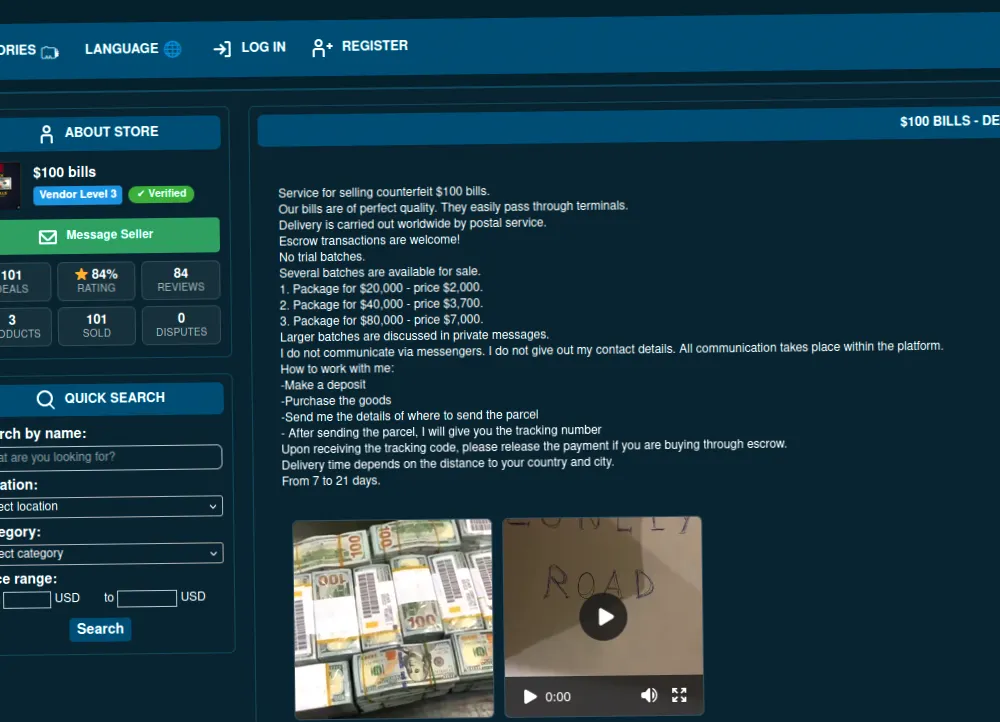
In January 2025, a 29-year-old individual named Derek H. from Denver devised a plan to exploit counterfeit cash. He acquired 40 fake $100 bills for $1,200 using cryptocurrency on a darknet market. The seller claimed these bills were of exceptional quality, mimicking genuine currency closely.
Derek’s strategy involved depositing these counterfeit notes into cash-accepting ATMs. If the machines approved the deposits, he could access the funds like regular money. Initially, everything went smoothly. Two ATMs accepted the fake bills, allowing him to deposit a total of $800.
However, complications arose. One ATM flagged a bill, and while another accepted his deposit, it marked the transaction for review. The next day, he found his account frozen. Just three weeks later, federal authorities apprehended him, revealing the significant dangers tied to such illegal schemes.
Key takeaways
A Denver man bought 40 fake $100 bills for $1,200 on a darknet marketplace in January 2025
ATMs credited $800 before flagging suspicious transactions for manual review
Banks verify all cash deposits within 24–48 hours using UV light and magnetic tests
The Secret Service arrested him three weeks after the first deposit using surveillance footage
He faces up to 60 years on federal counterfeiting and fraud charges
The Darknet Purchase
In early January, we stumbled upon a site selling counterfeit money on a popular darknet platform. This listing advertised fake $100 bills from the 2009 series. Each note was priced at $30, with a minimum purchase of 40 notes.
The seller asserted that these counterfeit bills had security features to pass initial inspections. They included UV reactive ink, magnetic strips, watermarks, and color-shifting ink. Reviews highlighted successful transactions at small stores and vending machines.
Derek spent $1,200 in cryptocurrency for the batch. The package reached his Denver home in 11 days without any customs problems.
The ATM Deposit Scheme
Automated teller machines for cash deposits utilize sensors to evaluate bills. They assess size, ink characteristics, and security threads embedded in the currency. However, these machines don't employ the comprehensive checks that bank tellers do.
Derek tested four ATMs over a span of two days. To stay under the radar, he deposited five bills at a time. A vendor from the darknet had recommended this strategy to minimize risk.
The first ATM credited him with $500 right away. The second one added $300 instantly. The third ATM returned a counterfeit $20 bill, as he had mixed notes. Lastly, the fourth machine accepted his bills but marked the transaction as pending.
He thought that once the digital balance reflected the funds, they would be legitimate entries. Withdrawing them from another location felt like the final move.
How the Bank Caught Him
Every cash deposit is subject to backend verification within 24 to 48 hours. This process ensures that each transaction is thoroughly checked, not just by machines but by bank personnel. When Derek made his fourth deposit, it set off an automatic examination due to the ATM's optical scanner identifying issues with the security thread's placement. Staff removed the bills from the machine's cassette for further evaluation.
Upon inspection under UV light, the counterfeit dollar bills exhibited incorrect fluorescence patterns. The magnetic ink used did not meet standard testing requirements. Additionally, the texture of the paper was inconsistent with that of genuine Federal Reserve notes. This led the bank to flag all recent deposits associated with Derek's account for further scrutiny.
Consequently, they froze his account and notified the Secret Service. Federal agents were able to trace the deposits back to specific ATMs and examined surveillance footage. Just three weeks after the initial deposit, Derek was apprehended in his apartment.
Derek found a fake money site on a popular darknet marketplace in early January.
Legal Consequences
Possession of buy fake dollars with intent to defraud is a federal crime under 18 U.S.C. § 472. Manufacturing or passing counterfeit currency carries up to 20 years in prison. Each bill counts as a separate offense.
Derek faced charges for 40 counts of possessing fake counterfeit money. Additional counts included bank fraud and wire fraud for the digital transfers. The total potential sentence exceeded 60 years.
He accepted a plea deal in March 2025. Sentencing is scheduled for June. Prosecutors recommend eight years in federal prison. He must also pay restitution to the bank for investigative costs.
The Secret Service tracked the darknet vendor through blockchain analysis. The marketplace shut down the listing. No arrests of the seller have been announced publicly.
Why Prop Money for Sale Nearby Isn't Safer
Many shoppers look for local sources of fake currency. They think buying nearby minimizes shipping hazards or scrutiny from authorities. This belief does not lessen the chances of detection at banks.
All financial institutions adhere to the same federal verification processes. Where the money originates has no bearing. ATMs and bank tellers utilize the same technology across the country.
Some sellers promote purchasing counterfeit $20 bills or smaller denominations, suggesting these attract less attention. However, banks investigate any suspicious deposits, regardless of the bill’s value. Counterfeit $20 bills undergo the same scrutiny as fake $100 bills.
The main issue isn't the purchase location. It’s that today’s banking systems check every single bill through several verification steps. No counterfeit consistently passes all these checks.
The Bottom Line
Derek's scheme failed because ATMs are only the first filter. Backend verification catches what machines miss. Surveillance footage ties the fraud to individuals within days.
Buying counterfeit $100 dollar bill batches from darknet markets doesn't grant anonymity. Cryptocurrency transactions leave blockchain trails. Shipping addresses create physical evidence. Banks and federal agencies coordinate across jurisdictions.
The case shows why prop money scams collapse under institutional scrutiny. No forgery defeats layered authentication. The risk isn't worth the inevitable federal prosecution.
 Deepweb List: A Quick ReferenceExplore our curated deep web list for safe access to hidden services and resources. Find essential .onion links and tools for your journey.
 Onion Link Browser: Accessing Hidden ContentDiscover how to use an onion link browser to access hidden .onion sites safely and securely. Explore the dark web with confidence and priva…
 Hidden Wiki Tor Browser: Navigating SafelyExplore the Hidden Wiki using Tor Browser safely. Discover essential tips for secure navigation and accessing hidden services.